

Orchestrated Intelligence
What the top consulting firms predict on Agentic AI for 2026 and beyond.

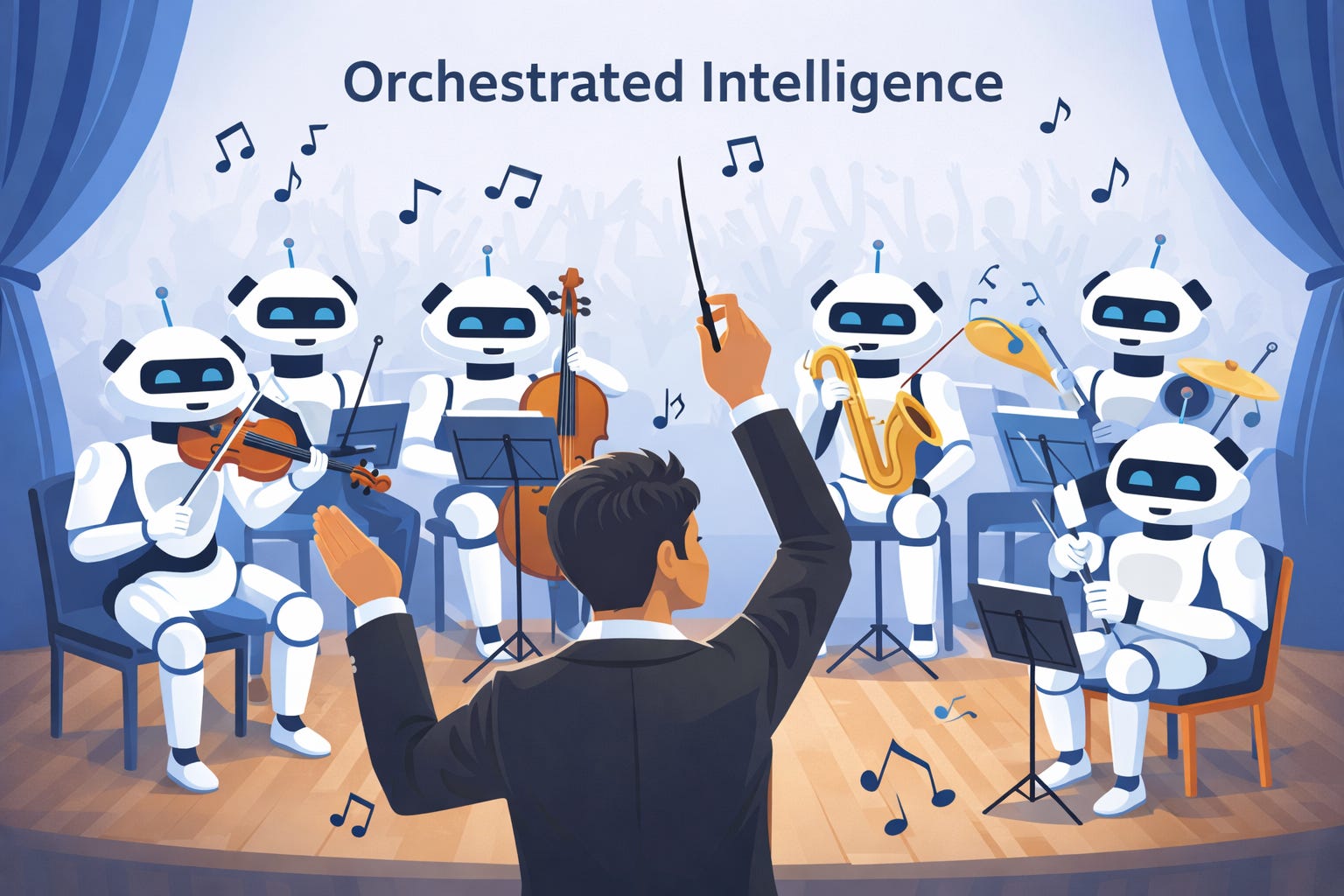
In Q4 2025, every major consulting firm discovered agentic AI in healthcare. The timing was orchestrated: Year-end reports, 2026 predictions, positioning for next year’s enterprise contracts. Let’s take a look at what some of those in the business of thought leadership had to say.
COMMON THEMES ACROSS ALL FIVE:
1. Autonomy & Agency
All position agentic AI as systems that don’t just respond but “act,” “reason,” “plan,” and “execute” autonomously
McKinsey: “virtual workers” that complete workflows end-to-end
AWS: systems that “understand, anticipate, and respond”
GE Healthcare: “break down silos” through proactive orchestration
EY: “distributed ecosystem of interoperable agents”
Deloitte: “digital workforce” that identifies, plans, executes tasks
2. Multi-Agent Orchestration
All emphasize coordinated systems with specialized agents working together
McKinsey describes orchestration/task/review/planning agents
AWS/GE focus on Model Context Protocol (MCP) for agent coordination
Deloitte emphasizes “multiagent systems” with role-specific collaboration
3. Human-in-the-Loop
All include this caveat, especially for healthcare
McKinsey: “strategically placed human” as “critical safeguard”
EY: “checkpoints to validate outputs”
Consistent acknowledgment of governance needs
4. Workflow Transformation
All frame this as redesigning processes, not just optimizing them
Focus on admin burden reduction (claims, scheduling, documentation)
Promise of freeing clinicians for higher-value work
WHAT THEY’RE CLAIMING:
McKinsey:
85% of healthcare leaders already implementing/pursuing GenAI
AI agents can handle administrative tasks (40% of hospital expenses)
Multiagent systems for complex workflows across payers/providers
AWS:
Real implementations: Availity achieved 2X faster data insights, 75% reduction in release management reviews
Breaking down “healthcare’s walls” through proactive care delivery
Purpose-built solutions for appointment management, patient engagement
GE Healthcare:
Partnership with AWS to build multi-agentic systems for radiology, oncology
Example: coordinating cancer treatment plans across multiple data sources
Emphasis on reducing research time from “months to days”
EY:
WHO projects 11M healthcare worker shortfall by 2030
88% of health leaders trust AI; 85% think adoption isn’t fast enough
Focus on “agentic mesh” - distributed, interoperable ecosystem
Strong emphasis on data foundations, open standards
Deloitte:
Predicts 25% of companies will launch agentic AI pilots in 2025, 50% by 2027
Survey of 1,854 execs shows rising AI spend but “elusive ROI”
Launched “Global Agentic Network” in May 2025
Emphasis on RPA vs APA (agentic process automation)
WHAT’S OVERSTATED OR MISSING OR UNDEREMPHASIZED IN ALL OF THEM:
Co-creation with frontline clinicians - The suggested trust in AI from these reports may be overstated. Clinicians, who bear the human responsibility and legal liability, want design control for AI inserted into their workflows.
When agents should doubt themselves - Epistemic humility is lacking, by design, in these agents. They are designed to guesstimate based on probabilities, even when data are missing. AI agents need to know how to say “I don’t know.”
Equity/bias concerns - Minimal discussion of data reflecting past inequities. GIGO or garbage in, garbage out needs to be addressed.
Real implementation challenges - These are vision documents, not implementation stories.
Cost of getting it wrong - Healthcare safety stakes need more than “human oversight” or “human in the loop.” Deliberate design choices need to ensure the tech itself is safer.
So where does this leave us heading into 2026? The consulting firms have made their predictions. The technology is advancing rapidly. But several fundamental questions remain open: Can we build agents that know when to escalate rather than guess? How do we design for equity when training data reflects historical bias? What does meaningful co-creation look like when introducing autonomous systems into high-stakes clinical workflows? These aren't rhetorical questions—they're active areas of research and development.
What approaches are you exploring?